
Can You Surgically Change Your Eye Color? The Comparison of the 3 Techniques
The desire to permanently change one’s eye color is no longer restricted to contact lenses and wishful thinking. Three distinct surgical techniques now exist — each with its own mechanism, risk profile, permanence, and price point. This guide gives you the complete medical picture so you can make an informed decision, and explains why keratopigmentation at FLAAK in Paris represents the current gold standard for safe, permanent eye color change.
The Three Surgical Methods: An Overview
Before comparing the methods in detail, it is important to establish what we mean by “surgical.” All three techniques involve a medical intervention inside or on the eye — they require a qualified ophthalmologist, a clinical setting, and formal pre-operative assessment. None of them are suitable for performance by non-medical operators, regardless of how they may be marketed in some markets.
Method 1: Iris Implants (Phakic Intraocular Lenses)
An iris implant — also called a colored phakic IOL (intraocular lens) — is a small, flat silicone disc tinted in the desired color, surgically placed in the anterior chamber of the eye, in front of the natural iris. The procedure involves creating a small corneal incision through which the implant is inserted and positioned.
Advantages:
- Theoretically reversible — the implant can be removed
- Can simulate virtually any color including light shades
- No corneal tissue modification
Documented risks:
- Glaucoma: Multiple studies and national health authority warnings document elevated intraocular pressure (IOP) as a significant risk — occurring in a meaningful percentage of patients, sometimes years after implantation
- Cataract formation: Contact between the implant and the crystalline lens can accelerate lens opacification
- Corneal endothelial cell loss: The implant in the anterior chamber reduces the distance to the corneal endothelium, leading to progressive cell loss that can threaten corneal clarity
- Explantation complexity: While “reversible” in theory, implant removal is itself a surgical procedure with its own complications, and cannot always restore the pre-implant state
Multiple national health authorities — including the FDA (USA), ANSM (France), and NICE (UK) — have issued warnings or restrictions regarding cosmetic iris implants. The BrightOcular device, for example, was denied FDA approval for cosmetic use due to its unacceptable risk-to-benefit profile.
Method 2: Laser Iris Depigmentation (Lumineyes)
Laser iris depigmentation — marketed under brand names such as Lumineyes — uses a low-energy laser to selectively destroy melanin granules in the anterior stroma of the iris. Over a series of sessions (typically 6–8 treatments), the iris gradually lightens as melanin is ablated. The result is a shift from dark eyes toward lighter shades — theoretically blue or grey.
Advantages:
- Non-incisional — no cuts in the eye
- Can lighten very dark eyes
Documented risks:
- Glaucoma: The destroyed melanin granules disperse into the aqueous humor and can clog the trabecular meshwork — the eye’s drainage system — leading to elevated IOP and glaucoma. This risk increases with the number of treatment sessions.
- Irreversibility: Unlike iris implants, depigmentation cannot be reversed. Once melanin is destroyed, it cannot be restored.
- Unpredictable outcome: The final color achieved varies significantly between patients depending on baseline iris pigmentation, genetics, and individual response. Many patients do not achieve the blue color they expected.
- Lack of long-term data: The technique is relatively recent, and follow-up studies extending beyond 5–7 years are limited.
Method 3: Keratopigmentation (FLAAK Method)
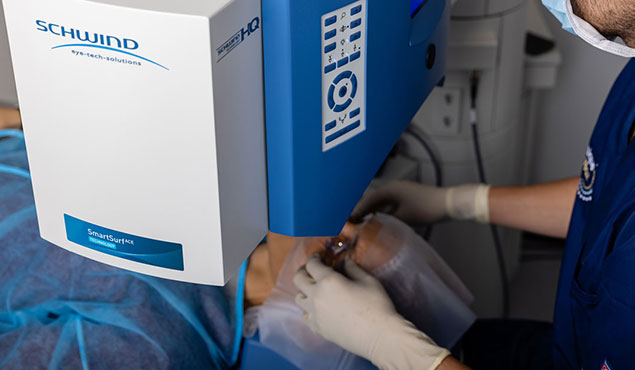
Keratopigmentation deposits biocompatible pigments within the corneal stroma — a layer of the cornea located anterior to the iris. The procedure uses the VisuMax femtosecond laser to create a precise intrastromal pocket in the peripheral cornea (outside the optical zone), into which pigment is introduced via a microsurgical cannula. The result is a permanent change to the apparent color of the iris as perceived from outside the eye.
Advantages:
- Does not involve the anterior chamber — no risk of intraocular pressure elevation via the drainage angle mechanism
- Does not destroy iris tissue
- Permanent and stable — published data shows stable color at 5+ year follow-up
- Natural-looking depth and translucency — pigment integrates with corneal stroma
- Femtosecond laser precision eliminates manual-technique risks
- Validated biocompatible pigments eliminate toxicity risks
Limitations:
- Best suited for moving from lighter to darker colors (cannot lighten dark eyes)
- Not suitable for all patients — candidacy requires corneal thickness and health assessment
- As with all surgical procedures, operator skill and patient selection are determinant factors in outcome
Side-by-Side Comparison: The Three Methods
| Criterion | Iris Implant | Laser Depigmentation | Keratopigmentation (FLAAK) |
|---|---|---|---|
| Direction | Any → any | Dark → light only | Any → darker |
| Reversibility | Theoretically reversible | Irreversible | Permanent (no reversal) |
| Glaucoma risk | Documented (IOP elevation) | Documented (trabecular clog) | Minimal (no anterior chamber entry) |
| Iris tissue | Covered — not altered | Permanently destroyed | Not touched |
| Corneal tissue | Not altered | Not altered | Stroma pocket — outside optical zone |
| Number of sessions | 1 surgery | 6–8 sessions over months | 1 surgery |
| Recovery | 2–4 weeks | Cumulative (months) | 7–14 days |
| Result predictability | High (color of implant is set) | Low–moderate (variable outcome) | High (controlled pigment) |
| Regulatory status | Restricted in many countries | Limited regulation | Medical procedure — ophthalmologist required |
| Price at FLAAK | N/A | N/A | From €5,500 |
Why Keratopigmentation Has the Most Favorable Safety Profile
The safety hierarchy among the three methods becomes clear when examining the anatomical location of each intervention and its associated risk pathways.
Iris implants place a foreign body in the anterior chamber — the fluid-filled space between the cornea and the lens. This space contains the trabecular meshwork (the eye’s drainage system) and the corneal endothelium (the innermost corneal layer). Any disruption to either structure can cause glaucoma or corneal decompensation — both serious, vision-threatening conditions.
Laser depigmentation liberates melanin particles into the aqueous humor, where they can migrate to and partially obstruct the trabecular meshwork. This is not a theoretical risk — it has been documented in published case series and is the primary reason most reputable ophthalmological societies do not endorse the procedure.
Keratopigmentation avoids both these risk pathways entirely. The procedure targets the corneal stroma — outside the anterior chamber, outside the optical zone, and anatomically separated from the trabecular meshwork by multiple tissue layers. The pigment remains within the stromal pocket, encapsulated by surrounding keratocytes, without access to the anterior chamber fluid or the drainage system.
This anatomical logic — not marketing — is the scientific basis for FLAAK’s confidence in recommending keratopigmentation over the alternatives.
The FLAAK Difference: Ophthalmological Precision in Paris
Not all keratopigmentation is equal. The technique exists on a spectrum from manual needle procedures (performed by non-ophthalmologists in unregulated markets) to femtosecond laser-guided surgery performed by board-certified ophthalmologists in certified surgical facilities.
At FLAAK in Paris, every procedure is:
- Performed exclusively by a board-certified ophthalmologist
- Guided by the VisuMax femtosecond laser — the standard for corneal precision surgery
- Performed using certified biocompatible pigments validated for ophthalmic use
- Preceded by a complete ophthalmological workup (corneal mapping, pachymetry, endothelial cell count, IOP)
- Followed by structured post-operative care at 1 week, 1 month, and 3 months minimum
This standard — which is the norm in Paris and across France’s regulated medical environment — is not universal. Patients considering keratopigmentation abroad should verify not only the procedure’s availability but the credentials of the operator, the technology used, and the regulatory framework governing the facility.
Who Is a Good Candidate for Keratopigmentation at FLAAK?
Ideal candidates for keratopigmentation at FLAAK typically share the following profile:
- Age 18 or older, with stable refraction
- Healthy corneas with sufficient stromal thickness for pocket creation
- Normal intraocular pressure
- No active ocular inflammatory disease
- Realistic expectations about the color range achievable through pigment deposition (darker tones, not lightening)
- Desire for a permanent result — not an interim aesthetic experiment
Candidates who are excluded include those with keratoconus, very thin corneas, active glaucoma, uncontrolled systemic autoimmune disease affecting the eyes, or those who are pregnant or breastfeeding.
Pricing and Next Steps
Keratopigmentation at FLAAK starts at €5,500 for both eyes. This includes the full pre-operative assessment, the surgical procedure, immediate post-operative care materials, and follow-up consultations.
The first step is a free consultation — available via WhatsApp for prospective patients based outside Paris. During this consultation, you can discuss your color goals, ask questions about the procedure, and understand whether you are likely to be a suitable candidate before committing to the in-person examination.
FLAAK accepts patients from across Europe, the Middle East, and internationally. Our team can assist with logistical guidance for medical tourism patients including suggested Paris accommodations and visit planning for a 3-day minimum stay.
Frequently Asked Questions
Is keratopigmentation FDA approved?
Keratopigmentation is not currently FDA-cleared as a cosmetic device in the United States. In France, the procedure is performed under the French medical device and pharmaceutical regulatory framework. FLAAK uses CE-marked equipment and EU-compliant biocompatible pigments.
Can the color be changed again after the procedure?
A second procedure to intensify or modify color is technically possible if sufficient stromal depth remains, but requires individual assessment. The procedure is designed as permanent — patients should approach it with that commitment in mind.
How long do I need to stay in Paris after the procedure?
We recommend a minimum 3-day stay: surgery day plus a follow-up check at 48 hours before departure. The J7 follow-up can be conducted remotely via video consultation for international patients in most cases.
Does the procedure affect vision?
When performed correctly — with the pigment deposited peripherally, outside the optical zone — keratopigmentation does not affect visual acuity. All FLAAK patients undergo pre- and post-operative visual function testing to confirm this. Temporary blurring in the first few days is expected and resolves as the cornea heals.
Medical Safety and Clinical Standards
Permanently changing your eye color is now a medical reality, thanks to decades of advancement in keratopigmentation techniques and biocompatible materials science.
Keratopigmentation allows patients to achieve their desired eye color with remarkable precision. Whether the goal is blue, green, hazel, honey, or gray, the corneal technique deposits specially formulated biocompatible pigments into the corneal stroma through a safe intrastromal pocket created by a femtosecond laser. Unlike iris implants, which carry serious risks of glaucoma, uveitis, and endothelial cell loss, keratopigmentation works exclusively on the corneal surface without touching the iris, lens, or any internal structures of the eye.
The ophthalmologist surgeon performing the procedure in Paris uses an advanced 3D color simulation system during the free consultation Paris appointment, allowing patients to preview their transformation before committing to surgery. This simulation takes into account the patient’s natural iris pigmentation, corneal transparency, pupil size, and desired color intensity to produce a realistic preview of the final outcome. The combination of simulation technology and the surgeon’s artistic expertise ensures that expectations are perfectly aligned with achievable results. The outcome is a permanent result that does not fade, shift, or require periodic touch-ups.
The science behind the color change is rooted in optical physics: the biocompatible pigments absorb and reflect specific wavelengths of light within the corneal stroma, creating the appearance of a new iris color when viewed through the transparent corneal layers. This principle is similar to how the natural iris produces color through melanin distribution. The key advantage of keratopigmentation is that it achieves this effect externally to the iris, preserving the delicate iris tissue and its critical functions including pupil dilation and aqueous humor regulation. This approach maximizes medical safety while delivering exceptional aesthetic outcomes at a cost of approximately 5,500 EUR.
Every patient undergoes a thorough pre-operative assessment before being cleared for keratopigmentation surgery. This examination includes corneal topography mapping, pachymetry (corneal thickness measurement), endothelial cell count, intraocular pressure assessment, and a complete slit-lamp examination. Only candidates who meet strict eligibility criteria proceed to surgery, maintaining the highest standards of medical safety. Patients with active corneal pathology, severe dry eye syndrome, keratoconus, insufficient corneal thickness, or uncontrolled glaucoma are identified during the free consultation Paris session and advised of alternative options.
Permanent Results and Long-Term Patient Satisfaction
One of the most compelling aspects of keratopigmentation is its permanent result. Unlike colored contact lenses that must be inserted and removed daily, keratopigmentation offers a single procedure with lifelong results. The biocompatible pigments remain stable within the intrastromal corneal pocket, maintaining their color intensity, uniformity, and natural appearance over decades. Long-term follow-up studies spanning five to ten years confirm that the pigments do not migrate, degrade, or cause delayed inflammatory reactions.
Patient satisfaction surveys consistently demonstrate exceptional outcomes, with over 95% of patients reporting that the result met or exceeded their expectations. The before after transformations are documented through high-resolution clinical photography under standardized lighting conditions, providing an objective record of each patient’s journey. These images are available for review during the free consultation Paris appointment, allowing prospective patients to see real results from individuals with similar eye colors, skin tones, and aesthetic goals.
The procedure itself is remarkably efficient: each eye requires approximately 20 to 30 minutes, performed under topical anesthesia (eye drops only) with no general anesthesia, no injections, and no stitches. Most patients describe the experience as comfortable, with minimal sensation during the pigment injection phase. Recovery is swift, with the majority of patients returning to work and daily activities within 48 to 72 hours. Final color stabilization occurs progressively over two to four weeks as the corneal tissue fully heals around the biocompatible pigments.
Frequently Asked Questions About Keratopigmentation
Is keratopigmentation reversible?
Keratopigmentation is designed as a permanent result, which is one of its primary advantages over temporary solutions like contact lenses. However, should a patient ever wish to modify the outcome, the biocompatible pigments can be partially or fully removed by a qualified ophthalmologist surgeon using specialized femtosecond laser techniques. In clinical practice, revision procedures are extremely rare, as the vast majority of patients are fully satisfied with their transformation.
Does keratopigmentation affect vision or eye health?
No. The corneal technique deposits pigments exclusively in the peripheral and mid-peripheral cornea, carefully preserving the central optical zone that is responsible for visual acuity. Peer-reviewed clinical studies confirm that visual acuity, contrast sensitivity, color perception, and night vision remain completely unchanged after the procedure. The medical safety protocols used in Paris ensure that the pupillary axis is never compromised, and the corneal endothelium (the critical inner layer of the cornea) is fully protected throughout the surgery.
How much does keratopigmentation cost and what is included?
The complete keratopigmentation procedure is priced at approximately 5,500 EUR for both eyes. This all-inclusive price covers the initial free consultation Paris with comprehensive diagnostic imaging, the personalized 3D color simulation, the surgical procedure with premium biocompatible pigments, post-operative medications, and all follow-up appointments for the first year. There are no hidden fees or additional charges. Payment plans may be available upon request.
Who performs the surgery and where?
The keratopigmentation procedure is performed by a board-certified ophthalmologist surgeon with extensive experience in corneal surgery and aesthetic ophthalmology. The surgery takes place in a dedicated ophthalmic surgical center in Paris that meets the highest European standards for medical safety, sterility, and patient care. The surgeon personally conducts every consultation, performs every procedure, and supervises every follow-up visit.
How do I book a consultation?
Booking a free consultation in Paris is simple and takes less than a minute. Contact the clinic directly via WhatsApp to schedule your appointment. During the consultation, you will receive a complete eye examination, a personalized 3D simulation showing your future eye color, a detailed explanation of the corneal technique, and answers to all your questions from the ophthalmologist surgeon. The consultation is free of charge, with absolutely no commitment required. Many international patients combine their consultation with a visit to Paris, and the clinic can assist with scheduling to accommodate travel plans.